An insurance adjuster lowball offer is one of the most frustrating parts of a property claim. You see the damage, your contractor gives you a number, and then the carrier's estimate arrives at a fraction of it. Before assuming the worst, it helps to understand why estimates come in low, because the reason determines the fix.
Having written adjuster estimates myself, I can tell you that an insurance adjuster lowball estimate is often the product of omissions and assumptions rather than a deliberate decision. That is good news, because omissions can be corrected with documentation. Here is how to identify what was missed and push back effectively.
Why estimates come in low
- Limited inspection time: after major storms, adjusters may have very little time per property.
- Repair instead of replace: the estimate repairs a few roof slopes or a section of flooring rather than replacing what cannot be matched.
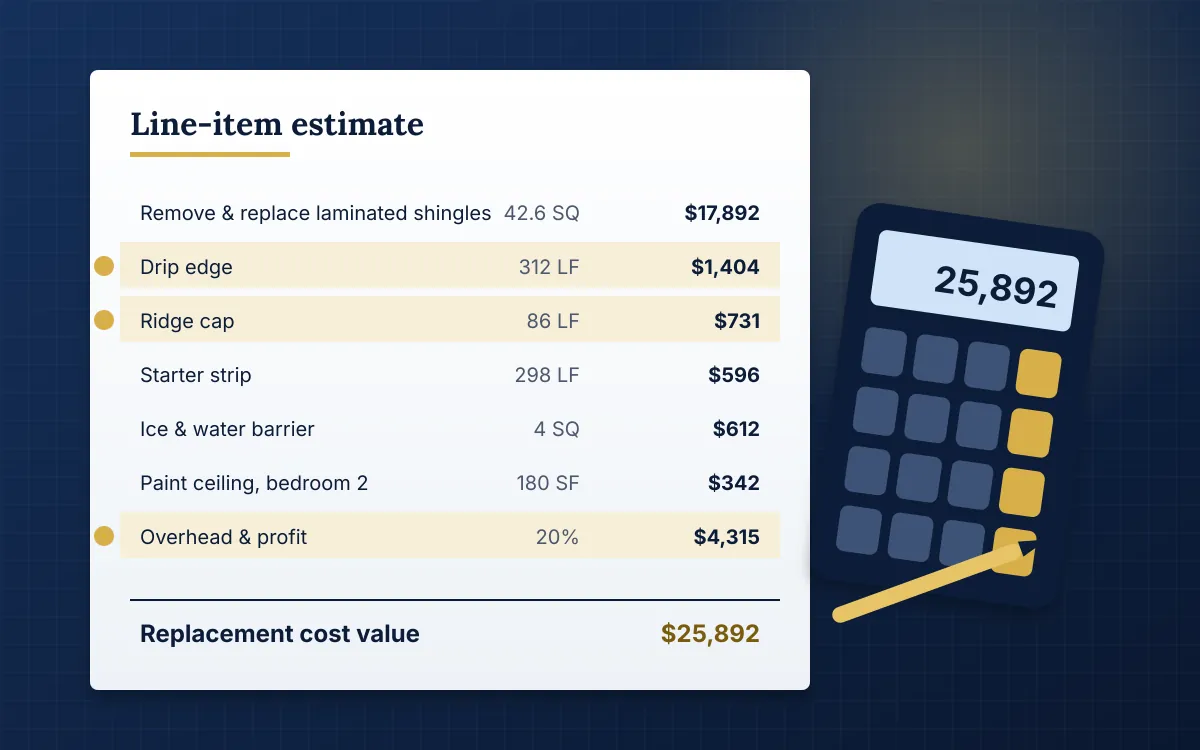
- Missing line items: drip edge, starter strip, ice and water shield where required, flashing, ventilation, detach and reset items, permit fees.
- Code upgrades left out: items required by current building codes that the original house did not have.
- No overhead and profit: general contractor charges omitted on jobs requiring multiple trades.
- Short measurements: quantities that do not match the actual roof or rooms.
- Pricing: unit costs that do not reflect current local labor and material prices.
- Heavy depreciation: depreciation applied aggressively, especially on actual cash value policies.
Why the first number is rarely the final number
On many claims the first estimate is a starting point. Carriers expect supplements on roofing and water jobs because hidden damage often appears once work begins, and because a fast catastrophe inspection cannot catch everything. That does not make a low first estimate acceptable, but it does mean the process is designed to be revisited. Policyholders who respond with organized documentation usually see the estimate move; those who simply accept the first number never find out what was left behind.
Step one: read the insurance adjuster lowball estimate line by line
Do not just look at the bottom line. Read every item. Look for what is included and, more importantly, what is not. Compare it to contractor bids room by room and slope by slope. Make a list of every discrepancy. Check the measurements against your own or a roofing measurement report.
Check the price list date
Carrier estimates are priced from regional price lists that are updated periodically. After a major storm, local labor and material costs can rise faster than the list reflects. Look at the price list code and date printed on the estimate. If your contractors are consistently quoting higher unit prices for the same items, document those quotes; pricing disputes are among the most common issues resolved through supplements and appraisal.
Step two: gather documentation
Support each discrepancy with evidence:
- Photos of damage that was missed, labeled by location.
- Contractor estimates with line-item detail, not just a lump sum.
- Manufacturer information showing discontinued products, for matching arguments.
- Local code requirements from the city building department.
- Invoices for emergency services and mitigation.
Step three: respond in writing
Send a written response to the adjuster listing each item you dispute and the supporting evidence. Be specific: “The estimate includes 22 squares of roofing; the measurement report shows 31 squares. Report attached.” Request a re-inspection if needed, and ask for a written explanation of any items they decline to include.
Keep your tone factual. The goal is to give the adjuster or examiner what they need to justify a higher number in their own file.
Step four: escalate if needed
If the adjuster will not move, ask for a supervisor review. If you believe the claim is being handled improperly, you can file a complaint with the Texas Department of Insurance. If the dispute is about the amount of loss and your policy has an appraisal clause, appraisal may resolve it without litigation.
Recoverable depreciation is part of the picture
A low first check is sometimes the result of depreciation rather than missing scope. On replacement cost policies, that withheld amount is usually paid once repairs are complete. Before arguing that an estimate is low, check whether the replacement cost total is reasonable and the gap is simply depreciation you can recover later. If the replacement cost itself is too low, then the scope or pricing is the issue.
Do not cash the check? Not quite
Many people worry that cashing an initial payment means accepting it. In most Texas property claims, cashing a check for the undisputed amount does not prevent you from pursuing more, unless you sign a release or settlement agreement. Read anything you sign carefully, and ask an attorney if a document looks like a release.
What not to do
- Do not inflate the claim to gain negotiating room. It undermines your credibility.
- Do not let a contractor negotiate as if they were your public adjuster. In Texas, only a licensed public adjuster can represent you on the claim for compensation.
- Do not let deadlines slip while you argue. Keep track of depreciation recovery and suit limitation periods.
Real examples of how a gap builds up
Here is how a typical DFW roof estimate can come in thousands of dollars short without any single dramatic decision:
- The roof measured 28 squares; the estimate used 24 because a detached garage roof was skipped.
- Waste factor was set lower than the roof's cut-up design actually requires.
- Starter course and drip edge were left off.
- Steep-pitch and high-roof labor charges were not included on a two-story home.
- Ventilation was not updated even though the city requires it during re-roofing.
- Gutters with obvious hail dents were marked cosmetic.
Each item looks small in isolation. Together they can represent a large share of the true cost. The fix is the same for each one: identify it, document it and ask for it specifically.
Contractor bid versus carrier estimate
Your contractor's bid may be a lump sum, while the carrier's estimate is line-item. That mismatch makes it easy for an adjuster to dismiss the contractor's number as simply higher. Ask your contractor for a line-item breakdown, ideally in the same format as the carrier's estimate. Then the comparison becomes item by item, and the adjuster has to address each difference.
When a public adjuster helps with an insurance adjuster lowball
If the gap is large, the claim is complex, or you simply do not have time to fight line items, a public adjuster can take over. We prepare a full estimate in the same software the carrier uses, attend re-inspections and negotiate on your behalf. Our supplemental claim service covers claims that were already paid but came up short.
Frequently asked questions
Is a lowball offer bad faith?
Not necessarily. Many low estimates result from incomplete inspections or omissions. Bad faith is a legal question; if you suspect it, consult a Texas attorney.
How long do I have to dispute an estimate?
It depends on your policy and Texas law. Many policies have suit limitation periods, often two years, and depreciation recovery deadlines. Act promptly.
Can I negotiate directly with the adjuster?
Yes. Many claims are resolved by submitting documentation and requesting a re-inspection. A public adjuster can handle this for you if you prefer.
Have a claim that does not add up? Get a no-cost review from a licensed public adjuster with 8 years adjusting claims.