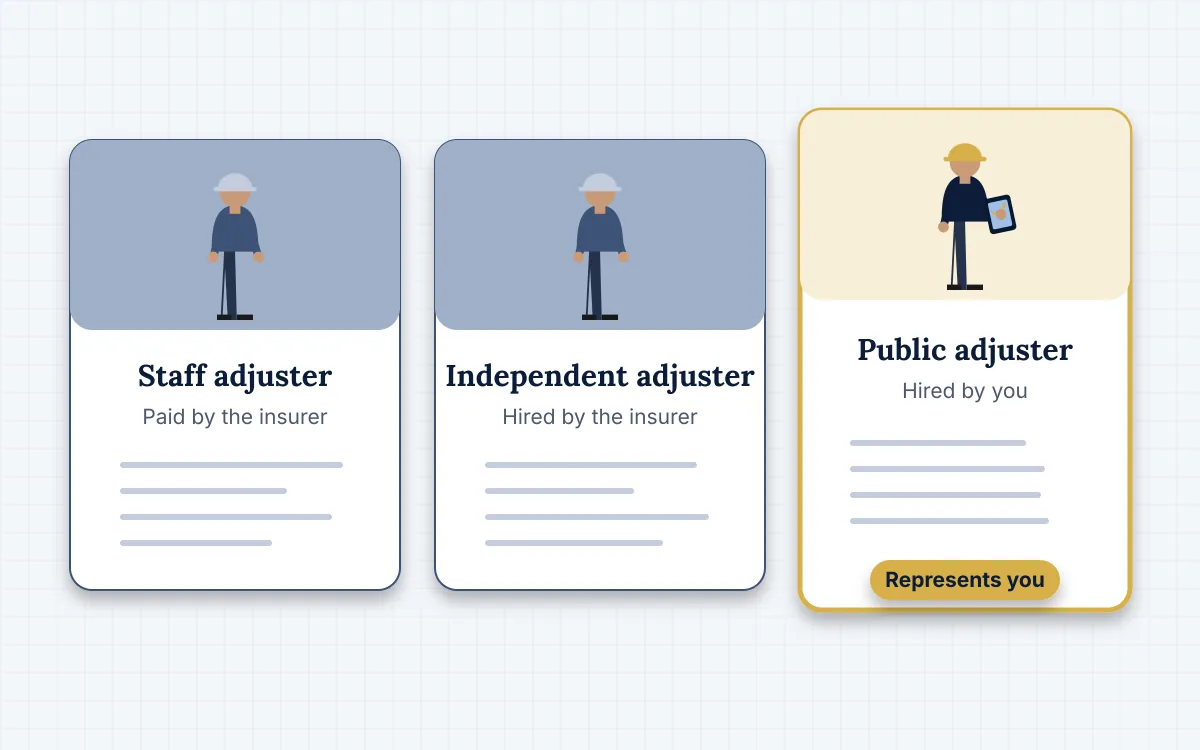
There are three main types of insurance adjusters you may meet on a Texas property claim: the company (staff) adjuster, the independent adjuster and the public adjuster. They can hold similar licenses, use the same estimating software and climb the same ladders. The difference that matters is simple: who hired them, who pays them, and whose interests they are obligated to look after.
Knowing the types of insurance adjusters helps you read the situation correctly. A friendly independent adjuster who says he is not with the insurance company is technically right, he is not on its payroll, but the carrier is still his client and the carrier signs off on his estimate. A public adjuster is the only one of the three who is contractually bound to you. The sections below explain each role, and the table compares them side by side.
Company (staff) adjusters
A staff adjuster is an employee of the insurance company. Large carriers employ staff adjusters in several forms:
- Field adjusters who inspect the property in person.
- Desk adjusters who handle smaller claims entirely by phone, photos and email, often reviewing images a contractor or a ladder-assist inspector took.
- Large-loss or general adjusters who take complex or high-dollar files.
Staff adjusters work within settlement authority limits. Above a certain amount, a supervisor or claims manager must approve the payment. That is why an adjuster may tell you on site that something looks covered, and then the written estimate arrives with it missing.
Independent adjusters (the independent insurance adjuster)
Independent adjusters (IAs) are licensed contractors that carriers hire, usually through an independent adjusting firm, when they need extra hands or specialized skill. After a big DFW hail storm, a carrier may send hundreds of IAs from out of state to work the surge. Texas licenses them, and during catastrophes the state can issue emergency adjuster licenses.
IAs are commonly paid per claim from a fee schedule that scales with the size of the loss, and their work is graded by the carrier. They are independent in the employment sense only. Their estimate goes to the carrier, the carrier decides what to pay, and the carrier decides whether they get the next storm assignment. Joseph worked as an IA on carrier assignments, so this description comes from experience, not theory.
Public adjusters
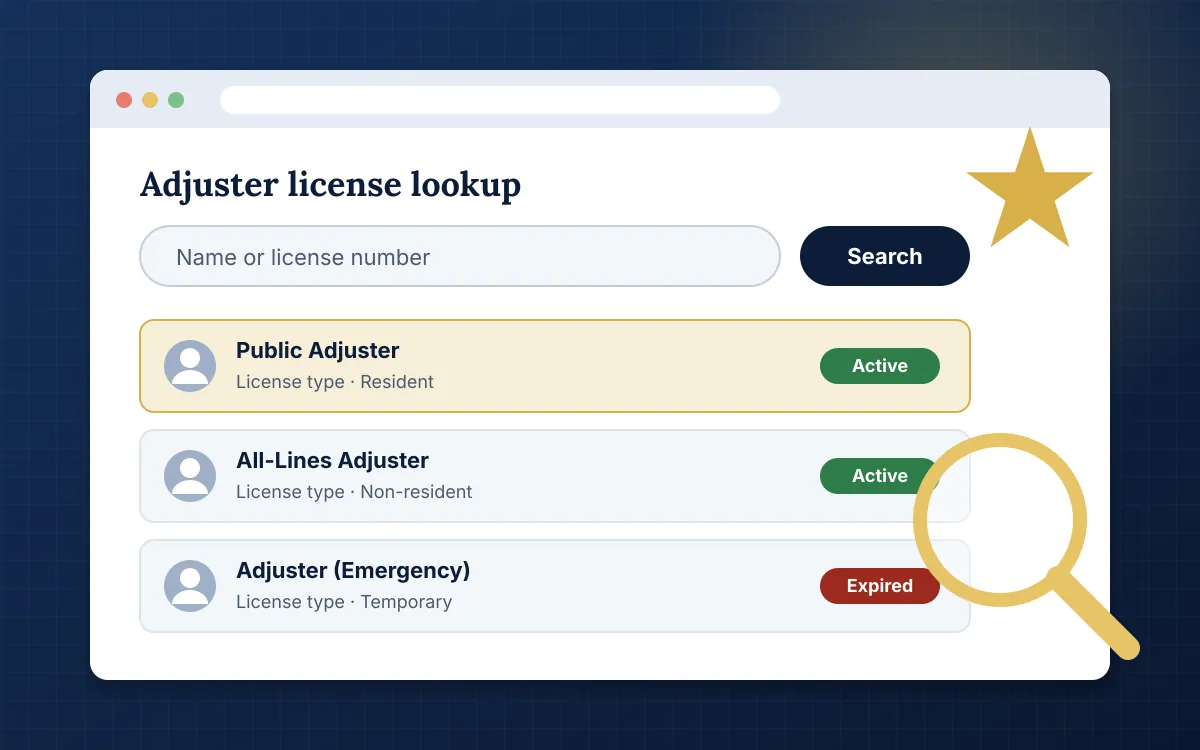
A public adjuster is licensed by the Texas Department of Insurance under Chapter 4102 of the Texas Insurance Code to act on behalf of the insured. You sign a written contract, the public adjuster prepares and presents the claim, negotiates with the carrier and handles the paperwork. The fee is a percentage of the claim payment, capped at 10% in Texas.
Public adjusters cannot give legal advice and are not lawyers. Their job is the claim itself: documenting the full scope of loss, pricing it accurately and pressing the carrier to pay what the policy owes.
Side-by-side: comparing the types of insurance adjusters
The table below summarizes how the three roles differ on a typical Texas homeowners or commercial property claim.
| Company (staff) adjuster | Independent adjuster | Public adjuster | |
|---|---|---|---|
| Hired by | Insurance company (employee) | Insurance company or TPA (contractor) | You, the policyholder |
| Paid by | Carrier salary | Carrier, often per-claim fee schedule | You, percentage of recovery |
| Cost to you | None directly | None directly | Contingency fee, capped at 10% in Texas |
| Represents | The insurer | The insurer | The insured |
| Who approves the estimate | Carrier supervisor / authority limits | Carrier examiner | Presented to carrier for payment |
| Typical workload | Steady caseload | Very heavy after catastrophes | Limited caseload by choice |
| Texas license | Adjuster license (some exemptions) | Adjuster license; emergency licenses after disasters | Separate public adjuster license, TDI Ch. 4102 |
| Can negotiate for you | No | No | Yes |
| Can invoke appraisal for you | No | No | Can prepare and support it; you or your representative invoke under the policy |
Frequently asked questions
Which type of insurance adjuster will inspect my house?
Usually a staff adjuster or an independent adjuster sent by your carrier. On small claims, a desk adjuster may handle everything remotely or send a ladder-assist inspector to take photos.
Is an independent adjuster on my side?
An independent adjuster is independent of the carrier's payroll but is hired and paid by the carrier. They are not your advocate. A public adjuster is the type of adjuster that represents the policyholder.
Can I have both the insurance company's adjuster and a public adjuster?
Yes, and that is normal. Your public adjuster works with the carrier's adjuster, meets them on site, and negotiates the estimate on your behalf.
Do public adjusters need a license in Texas?
Yes. Texas requires a public adjuster license issued by the Texas Department of Insurance, separate from the regular adjuster license. You can check a license with TDI's online lookup.
Have a claim that does not add up? Get a no-cost review from a licensed public adjuster with 8 years adjusting claims.