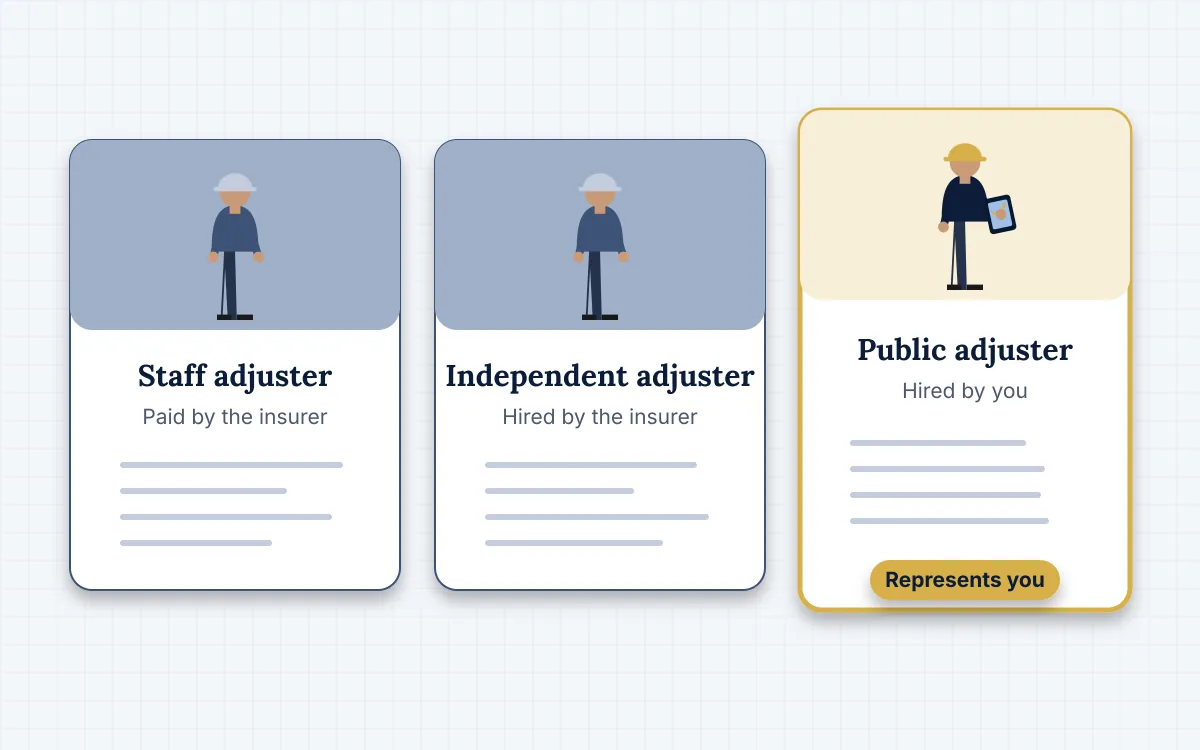
The public adjuster vs independent adjuster question confuses many policyholders, partly because both titles sound neutral. An independent adjuster sounds like an impartial referee. A public adjuster sounds like a government employee. Neither impression is right. The real difference is simple: an independent adjuster is hired by the insurance company, and a public adjuster is hired by you.
I have worked both jobs. I was an independent adjuster on carrier assignments, and now I am a licensed Texas public adjuster. So when people ask about public adjuster vs independent adjuster roles, I can explain how each one is assigned, paid, evaluated and what each is trying to accomplish on your claim.
What is an independent adjuster?
An independent adjuster (IA) is a licensed adjuster who is not an employee of the insurance company. Instead, carriers contract with IA firms, which assign their adjusters to claims. IAs are used when carriers need extra capacity, such as after a hail storm or hurricane, or when they need specialized skills, such as commercial or large-loss claims.
IAs are often paid per claim according to a fee schedule that rises with the size of the loss, though arrangements vary. Their work is reviewed by the carrier, and their future assignments depend partly on how the carrier rates their files. They follow the carrier's guidelines and submit their estimate to the carrier, which makes the payment decision.
“Independent” refers to their employment status, not their loyalty. The IA's client is the insurance company.
What is a public adjuster?
A public adjuster (PA) is licensed by the state to represent the policyholder. Texas public adjusters hold a TDI-issued license under Insurance Code Chapter 4102, distinct from the license carrier adjusters carry.
You hire a PA under a written contract. The PA reviews your policy, inspects the damage, prepares an estimate, communicates with the carrier and negotiates the settlement. The PA is paid a percentage of the claim payment, and Texas caps that fee at 10%.
How public adjusters are paid in Texas
The fee is a percentage of what the carrier pays on the claim, and Texas law caps it at 10%. Because the fee depends on the recovery, you pay nothing upfront for a claim review, and a public adjuster has a direct reason to document the claim thoroughly.
Public adjuster vs independent adjuster: side-by-side
| Independent adjuster | Public adjuster | |
|---|---|---|
| Hired by | Insurance company or its IA firm | Policyholder |
| Paid by | Carrier or IA firm | Policyholder, from the claim payment |
| Represents | Insurer | Insured |
| Texas license | Adjuster license | Public adjuster license, Chapter 4102 |
| Typical caseload | Very heavy after catastrophes | Smaller, chosen caseload |
| Cost to you | None directly | Contingency fee, capped at 10% in Texas |
For a broader look that includes staff adjusters, see our types of insurance adjusters comparison.

What it is like to be an independent adjuster after a storm
After a major DFW hail storm, an IA might be handed 100 or more claims at once. Each needs a call, an inspection, photos, a measurement, an estimate and a report. Carriers expect files closed quickly. Under that pressure, adjusters tend to write what is clearly visible and quickly documented. Hidden damage, code items, interior details and contents can get less attention.
Most IAs I worked with were honest and capable. But the structure of the job rewards speed and supportability. Nobody on that side is assigned to make sure you claim everything the policy owes you.
What a public adjuster does differently
A PA has a smaller caseload and a different incentive. Because the fee is a percentage of the recovery, the PA's interest lines up with yours: a complete and properly priced claim. A PA will:
- Read your entire policy, including endorsements.
- Inspect thoroughly, including attics, elevations, outbuildings and interiors.
- Write a detailed line-item estimate.
- Identify coverages you may not have thought of: code upgrades, debris removal, living expenses, contents.
- Handle the back-and-forth with the carrier.
- Prepare for appraisal if the dispute is about the amount.
A PA does not give legal advice. For coverage litigation or bad-faith claims, you need a Texas attorney.
Can an independent adjuster also be a public adjuster?
A person can hold both licenses, but on any given claim they work for one side only. A PA cannot represent you on a claim while also adjusting it for the carrier. When I became a public adjuster, I stopped taking carrier assignments so my only client on a claim is the policyholder.
Common misconceptions
- “The independent adjuster is a neutral third party.” Not in a legal or practical sense; the carrier is the client.
- “Public adjusters work for the government.” No. The word public refers to serving the insured public, not to government employment.
- “Hiring a public adjuster means suing the insurance company.” No. Most public adjuster claims are resolved through negotiation, and some through appraisal.
How each one is evaluated
Incentives shape behavior, so it helps to know how each role is judged. Independent adjusters are often graded by the carrier on file quality, cycle time and how well the estimate holds up in review. Supportability matters: an examiner wants every line item backed by photos and measurements, which tends to push estimates toward what is clearly visible. A public adjuster is evaluated by the client, and paid only from what is recovered, which pushes toward finding everything the policy covers. Neither system is sinister, but understanding them explains why two licensed adjusters can reach different numbers on the same house.
Public adjuster vs independent adjuster on a DFW hail claim
Picture a two-story home in Arlington after a spring hail storm. The independent adjuster, carrying a heavy catastrophe caseload, inspects the roof, counts hits in test squares, and writes replacement for the two slopes facing the storm. A public adjuster inspecting the same home documents those slopes too, but also identifies that the shingle line is discontinued, photographs dents in the gutters and window wraps, notes that the city will require updated ventilation on a re-roof, and includes steep-pitch labor. The final number depends on the negotiation, but the starting point is far more complete.
Which one should you call?
You do not choose the independent adjuster; the carrier does. The question is whether you also want a public adjuster representing you. For small, straightforward claims that are paid fairly, you may not need one. For large, complex, underpaid or denied claims, a PA can make a meaningful difference in how thoroughly your loss is documented. Our public adjuster services page explains when we can help.
Frequently asked questions
Is an independent adjuster neutral?
No. An independent adjuster is independent of the carrier's payroll but is hired and paid by the insurance company. They should be fair and follow the law, but they do not represent the policyholder.
Do I pay the independent adjuster?
No. The carrier or the IA firm pays the independent adjuster. You only pay a public adjuster if you choose to hire one.
Can my public adjuster work with the independent adjuster?
Yes. They routinely meet at the property for joint inspections and negotiate the estimate together.
Have a claim that does not add up? Get a no-cost review from a licensed public adjuster with 8 years adjusting claims.